Abstract
This article provides a conceptual–practical analysis of two approaches to strategy execution in organizations that manage project portfolios:
(1) Strategic Goals with quantitative indicators and an indirect connection to projects, and
(2) Strategic Pillars → Objectives & Key Results (OKR) with a weighted model for key results and direct traceability to initiatives.
The theoretical foundation combines classical strategy frameworks (Balanced Scorecard, Hoshin Kanri) and contemporary portfolio‑management approaches (PMI Standard for Portfolio Management, Lean Portfolio Management in SAFe), as well as practical OKR guidance (Niven & Lamorte; Doerr). Using the LEO PPM solution as an example, we show how goal‑achievement logs and OKR logs support regular monitoring (monthly and quarterly), KR weighting, and alignment of initiatives (ideas, requests, projects) with the selected strategic logic. A formula is presented for calculating Objective progress as the weighted sum of KR progress, and we provide criteria for selecting an approach based on organizational maturity, traceability requirements, team workload, and the risk of local optimization.
Practical contribution — a unified selection matrix and operational implementation steps in LEO PPM.
Theoretical contribution — a juxtaposition of goal‑based logic and pillar→OKR logic for strategy execution within modern portfolio management.
Keywords: strategy, project portfolio, OKR, Strategic Pillars, Balanced Scorecard, Lean Portfolio Management, traceability, weighted results.
1. Introduction
Executing strategy through project portfolios requires not only a coherent hierarchy of aims, but also transparent traceability “strategy → initiatives → results” and measurement cadences that enable adaptation. In practice, at least two approaches are common:
- Strategic Goals with quantitative achievement indicators that are only indirectly linked to projects;
- Strategic Pillars → Objectives & Key Results (OKR) where Key Results carry weights and specific initiatives directly influence results.
Purpose. To compare these approaches using theory and the real‑world operations of the LEO PPM solution, derive selection criteria, and offer implementation steps.
2. Theoretical Context and Related Approaches
- Balanced Scorecard (BSC) translates strategy into measurable objectives and indicators across four perspectives (financial, customer, process, learning/growth), effectively creating a “strategy map” with causal linkages. (Harvard Business School)
- Hoshin Kanri (policy deployment) cascades strategic priorities to unit goals and initiatives with regular review cycles. (Taylor & Francis; Internet Archive)
- OKR (Objectives & Key Results) focuses and aligns work: Objectives articulate qualitative strategic intent; Key Results specify measurable outcomes with periodic progress checks. (Wiley)
- Portfolio management (PMI) emphasizes aligning the portfolio with organizational strategy and the need for transparent portfolio governance. (Project Management Institute)
- Lean Portfolio Management (SAFe) recommends Strategic Themes at the portfolio level and measuring progress via OKR/KPI while maintaining an operational investment cadence. (scaledagileframework.com)
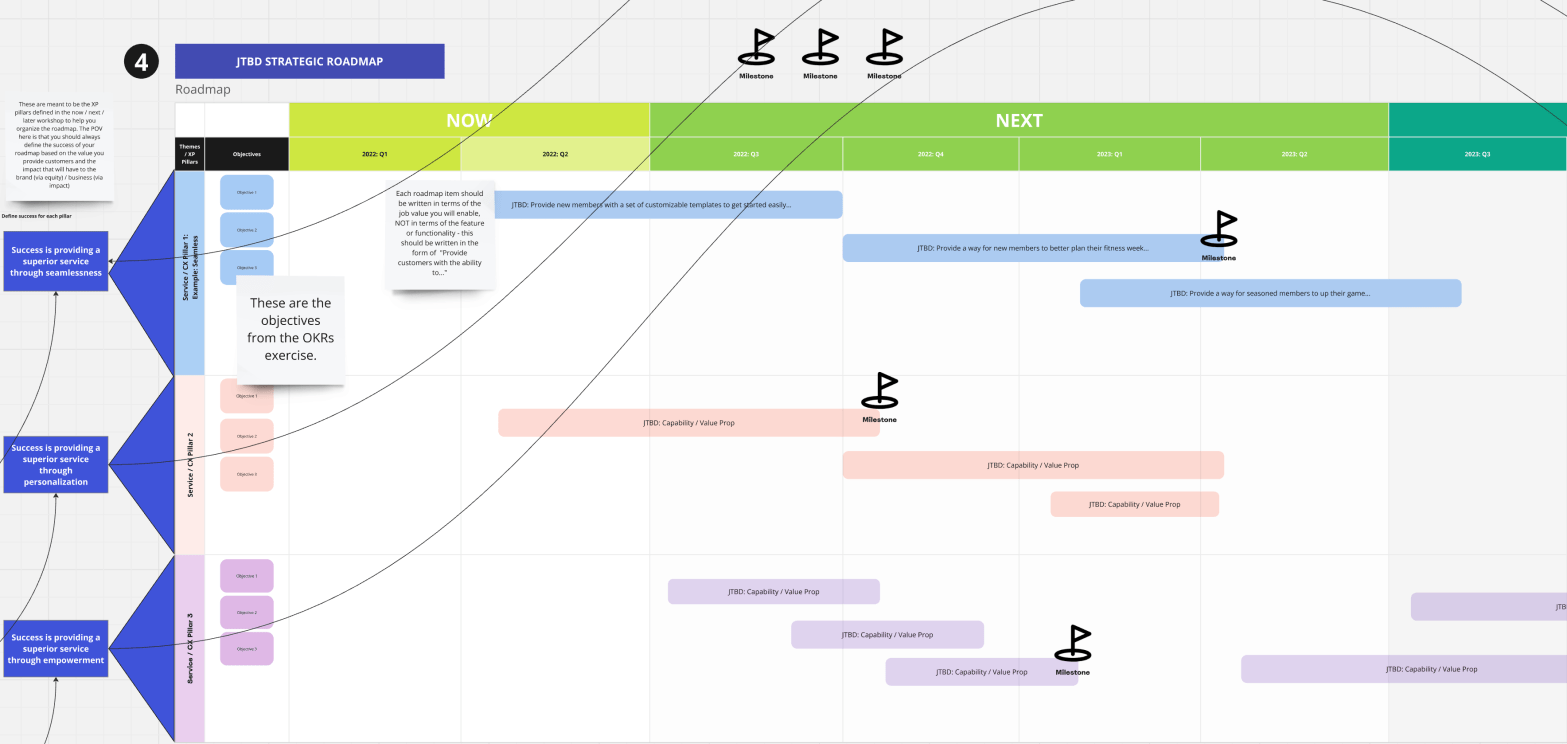
- Now–Next–Later roadmapping is widely used for release/roadmap planning to flexibly align horizontal “buckets” of work with OKR cycles. (Miro)
3. Methodology
This is a conceptual–applied study consisting of two parts:
- Criteria‑based comparison of the two approaches: traceability, governance, risk of local optimization, maturity requirements, and team workload.
- Illustrative LEO PPM case grounded in actual practices: goal/OKR logs, KR weighting, quarterly reviews, and integrations (e.g., Jira/Azure DevOps).
4. Terminology (harmonization of concepts)
- Strategic Pillars — the key directions or foundational elements on which the organization’s strategy rests. They focus effort and resources on achieving strategic aims and provide a structured basis for decision‑making and aligning projects, initiatives, and resources with the long‑term vision.
Example. For a technology company, pillars might include: Innovation & R&D; Customer Centricity; Operational Efficiency; Talent & Culture.
- Strategic Goals — long‑term, enterprise‑level targets that set direction and define desired outcomes (e.g., increase market share, improve profitability, enhance customer experience).
- Objective — an ambitious, inspirational, qualitative statement that defines the direction or target state the organization seeks to achieve. It may not be strictly SMART; progress is often tracked as a percentage (0–100%). Objectives are achieved through Key Results.
- Key Result (KR) — a clear, quantitatively measurable indicator that defines success for an Objective (e.g., “gain 500 new clients,” “increase NPS to 8,” “grow annual revenue by 20%”).
- Project — a temporary initiative to create a unique product, service, or outcome that contributes to strategic goals.
- Idea/Project Request/Initiative — an initial proposal that may grow into a full project, often sparked by market needs, internal innovation, or strategic intent.
5. Description of the Approaches
5.1. Approach 1 — Strategic Goals with quantitative indicators and an indirect link to projects
We start with a simpler scenario where a company has projects and project requests but no working OKR practice.

Figure 1. Schematic of the approach
First, verify whether current and potential projects are linked to strategy; formulate a list of Strategic Goals.
Create Strategic Goals and assign quantitative measures to each goal to understand progress over time.
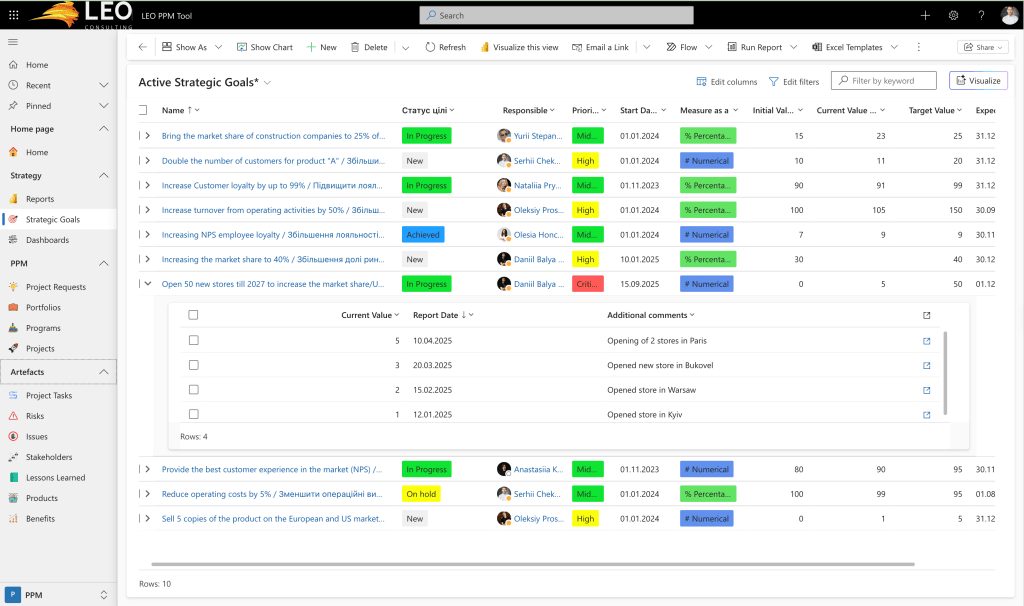
Figure 2. Registry of strategic goals with an achievement log in the LEO PPM solution
In this variant, the organization defines strategic goals (e.g., “increase sales 50% over two years,” “expand product capabilities”), chooses measures (%, count, currency), and maintains an achievement log updated monthly/quarterly.
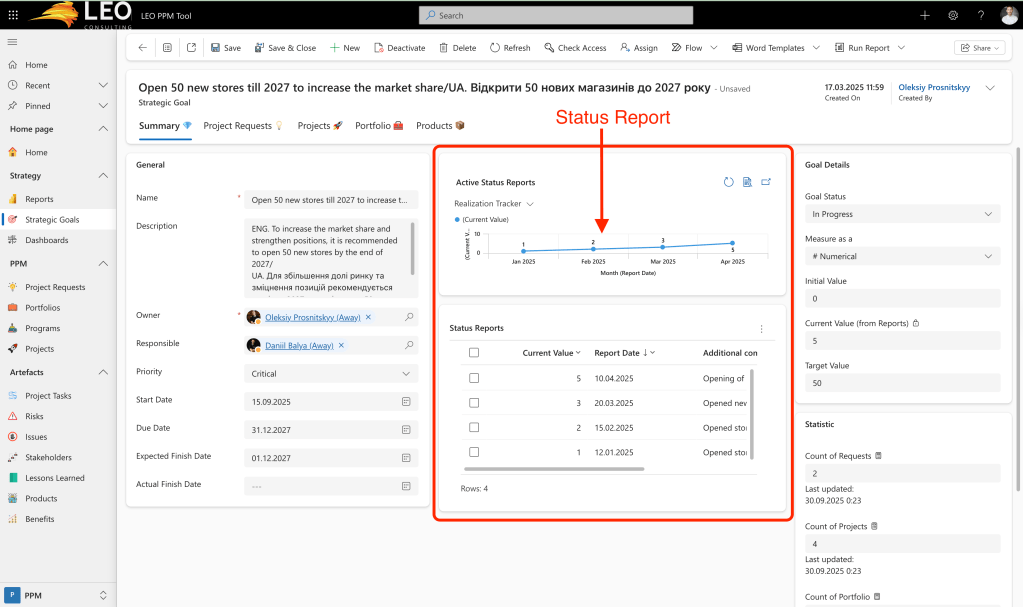
Figure 3. Change history log
Do projects necessarily drive goal attainment directly?
Ideally yes — project outcomes should advance strategic goals. However, it is possible to deliver all projects on time, ship quality products, or meet project‑level outcomes and still miss the strategic goal due to external factors.
Example. The goal is to grow market share by 20% in two years. Projects include:
— Developing a new mobile app (delivered on time with positive reviews);
— A social‑media marketing campaign (brand awareness up);
— Logistics optimization (costs down 15%).
Despite project success, competitors release an innovative product that captures more attention; the goal is not reached.
Therefore, the linkage should be established at the Idea/Project Request stage to decide whether a proposal supports any Strategic Goal. Upon approval, the idea/request is transformed into a project that is automatically linked to the Strategic Goal.
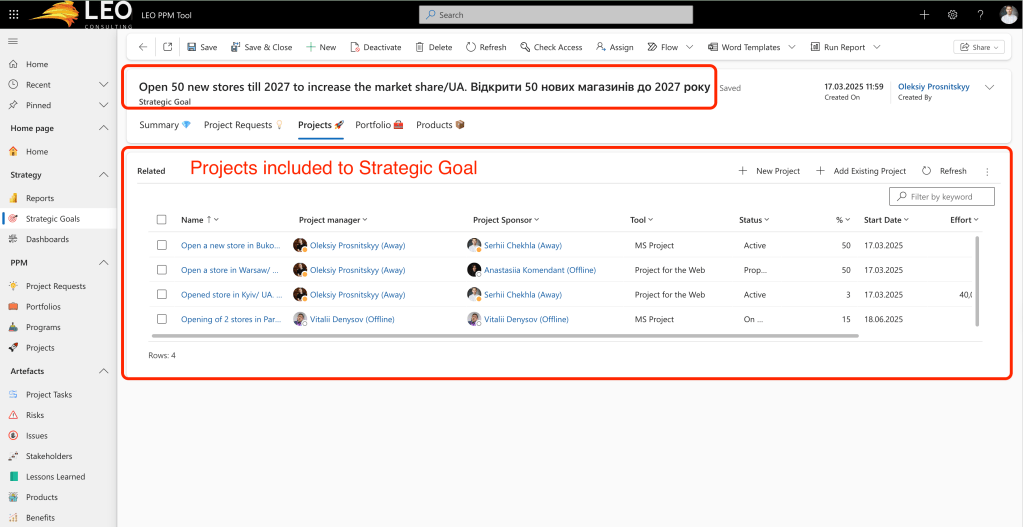
Figure 4. Projects included in a Strategic Goal
Advantages: simple metric reporting; flexible portfolio changes; easy leadership communication.
Limitations: indirect assessment of initiative impact; risk of “over‑achieving” metrics without business value; harder prioritization.
5.2. Approach 2 — Strategic Pillars → OKRs with KR weights and direct project traceability
I strongly recommend reviewing “Now / Next / Later Roadmapping & OKRs Playbook” by Chaz Mee; it clearly illustrates how this approach works (including graphics).
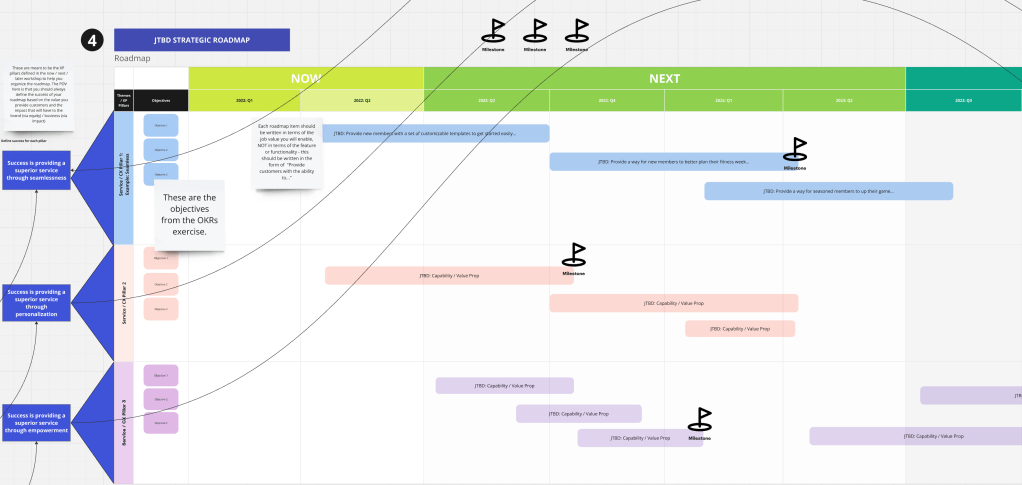
Figure 5. Schematic of the OKR based approach
Strategy is set via Pillars, under which Objectives and Key Results are formed and directly influenced by initiatives. In the LEO PPM solution, each KR has initial, target, and current values and a weight; the sum of KR weights for an Objective is 100%. Objective progress is computed as a weighted sum of KR progress:

We do not score “Improve Sales” (a Strategic Pillar) itself — unlike scoring a Strategic Goal in approach 1. A pillar is a fundamental direction that sets long‑term focus and priorities. Multiple Objectives live under a pillar, and Key Results live under each Objective.
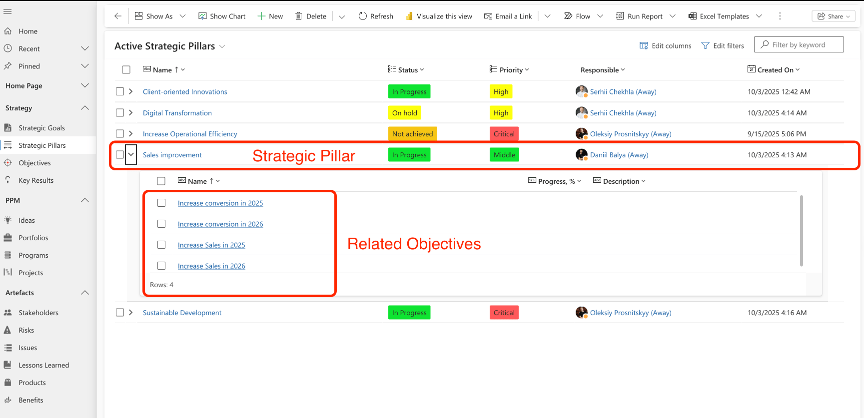
Figure 6.Strategic Pillars → Objectives
This creates traceability “initiative → KR → Objective → Pillar” and regular control (monthly/quarterly) via an OKR log.
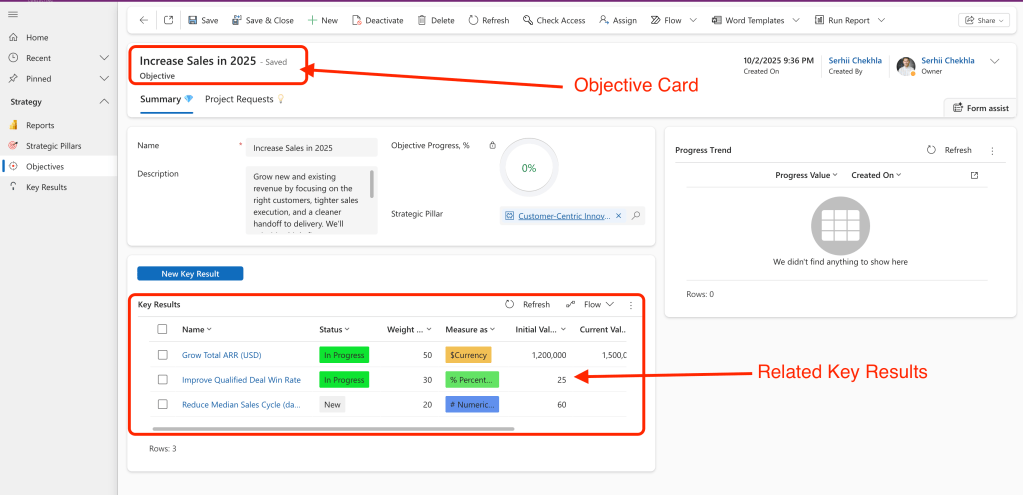
Figure 7. Objective card
Key Results are evaluated against three values: initial (at creation), target (desired), and current (at reporting time). We typically maintain a log and report monthly.
About KR weights. What are they and how do they affect OKR attainment?
An Objective is 100% when achieved in full — which is only possible if all included KRs (as represented in projects/initiatives) are complete.
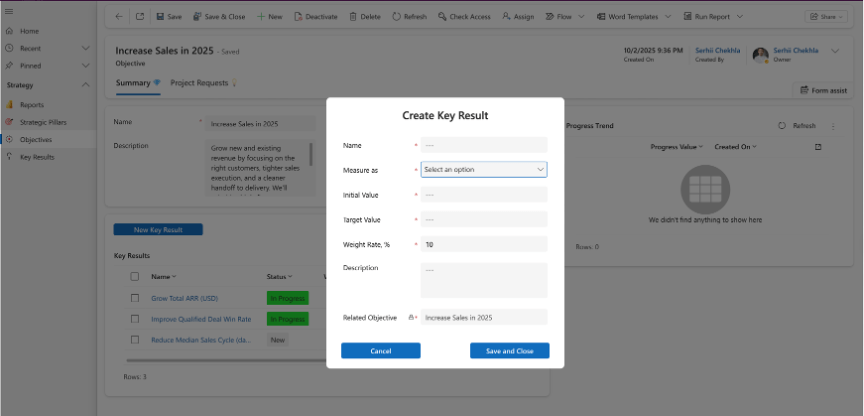
Figure 8. Key Result card.
Weights specify how each KR contributes to Objective attainment. In LEO PPM, the system prevents total KR weight from exceeding 100%. If one KR already weighs 50%, the next cannot be 51%.
The simplified OKR approach diagram looks like this.
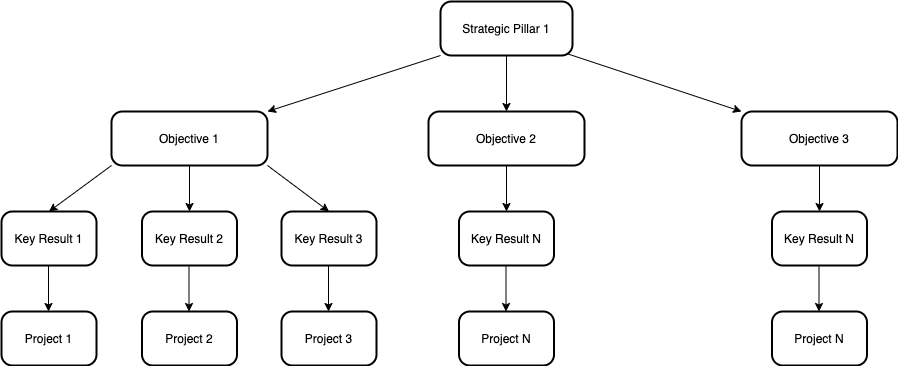
Figure 9. Schematic of the OKR approach.
Advantages: direct linkage between work and results; flexibility via KR weights; transparent team contribution; motivation from KR achievement.
Limitations: more complex tracking; risk of focusing on micro‑goals; higher team workload; requires mature processes.
6. Comparative Analysis (summary)
| Criterion | Strategic Goals | Pillars → OKR (with KR weights) |
| Traceability of initiative impact | Indirect; assessed through aggregate metrics | Direct: initiative → KR → Objective |
| Governance | Simple reporting, harder prioritization | Higher process requirements, but stronger governance |
| Risk of local optimization | Moderate (metrics detached from actions) | Possible (over‑focus on KRs); mitigated by weights/reviews |
| Maturity requirements | Suitable for starting/low maturity | Requires established portfolio‑management practices |
| Team workload | Lower | Higher (clear roles, regular tracking) |
(Generalized from LEO PPM practice and the literature.)
7. Illustrative LEO PPM Case (operational logic)
- Cadence. In the Goals approach — a strategic‑goals achievement log with quarterly updates. In Pillars→OKR — an OKR log with monthly & quarterly monitoring and corrective actions.
- Initiative generation. Both approaches use an ideas/requests funnel with subsequent selection (cost–resources–timeline). For market growth: R&D features, marketing, productivity optimization, and integrations (e.g., Jira/Azure DevOps).
- KR weighting. Sum of weights = 100%; the system warns on excess; Objective progress is a weighted sum, preventing “achieving” the Objective without its key results.
8. Discussion
Fit with classical frameworks.
- Goals aligns well with BSC (top‑level metrics) but needs a mechanism to pre‑trace initiatives (strategy map). (Harvard Business School)
- Pillars→OKR is close to Hoshin Kanri (policy deployment) and Lean Portfolio Management (Strategic Themes + OKR/KPI), where KRs provide measurability and weights provide balanced importance. (Taylor & Francis; SAFe)
Practical implications.
- For low/medium maturity, start with Goals (simplicity, quick start).
- For mature organizations needing transparent traceability, use Pillars→OKR + Now–Next–Later roadmaps (adaptivity between review cycles). (Miro)
Risks and safeguards.
- Goals: risk of “over‑achieving” metrics without business effect; address via metric quality and reviews.
- Pillars→OKR: risk of micro‑optimization to KRs; mitigate with weights, portfolio‑level reviews (PMI governance), and synchronizing OKRs with Strategic Themes/Pillars.
9. Conclusions
- Both approaches are viable: Goals for simplicity and a fast start; Pillars→OKR for measurable traceability and managing initiative contribution.
- Selection model. If you need transparent “project → result” linkages and governance via weights — implement Pillars→OKR. If you are just starting and lack process maturity — start with Goals.
- Operational steps in LEO PPM or another strategy‑execution tool: set cadences (monthly/quarterly), maintain logs (Goals/OKR), use KR weighting, and apply Now–Next–Later for an adaptive roadmap between reviews.
10. Recommendations for Implementation in the LEO PPM IT Solution
- Align a glossary: definitions of Strategic Goal, Strategic Pillar, Objective, KR; allowed measurement types.
- Configure structure in LEO PPM: Pillars/Goals → Objectives → KRs (with weights totaling 100%).
- Define linking rules: Idea/Request/Project must reference the relevant Goal or Objective/KR.
- Establish an update log (monthly/quarterly) and an SLA for refreshing KR/metric values.
- Launch core dashboards and regular leadership reviews (OKR/portfolio).
- Train teams on interpreting metrics and formulating high‑quality KRs.
- Pilot for 1–2 quarters, adjust the scheme, and scale across the organization.
11. Limitations and Caveats
- External factors (market/competition) may offset project contributions to goals.
- Poorly set KR weights distort the progress picture (control and review are mandatory).
- Weak discipline in updating logs/metrics reduces reporting reliability.
12. References
- Project Management Institute. The Standard for Portfolio Management (4th ed.). PMI, 2017. Project Management Institute
- Kaplan, R. S., & Norton, D. P. The Balanced Scorecard: Translating Strategy into Action. Harvard Business School Press, 1996; see also HBR (1992). Harvard Business School+1
- Akao, Y. Hoshin Kanri: Policy Deployment for Successful TQM. Productivity Press (reprint), 2005. Taylor & Francis
- Niven, P. R., & Lamorte, B. Objectives and Key Results: Driving Focus, Alignment, and Engagement with OKRs. Wiley, 2016. Wiley Online Library+1
- Doerr, J. Measure What Matters. Portfolio/Penguin, 2018. Amazon
- Scaled Agile Framework (SAFe). Strategic Themes; Lean Portfolio Management; OKRs. (SAFe 6.0 documentation). https://scaledagileframework.com/strategic-themes
- Miroverse (Chaz Mee). Now / Next / Later Roadmapping & OKRs Playbook. personify-strategic-planning-playbook-template/
 Serhii's Chekhla Blog